
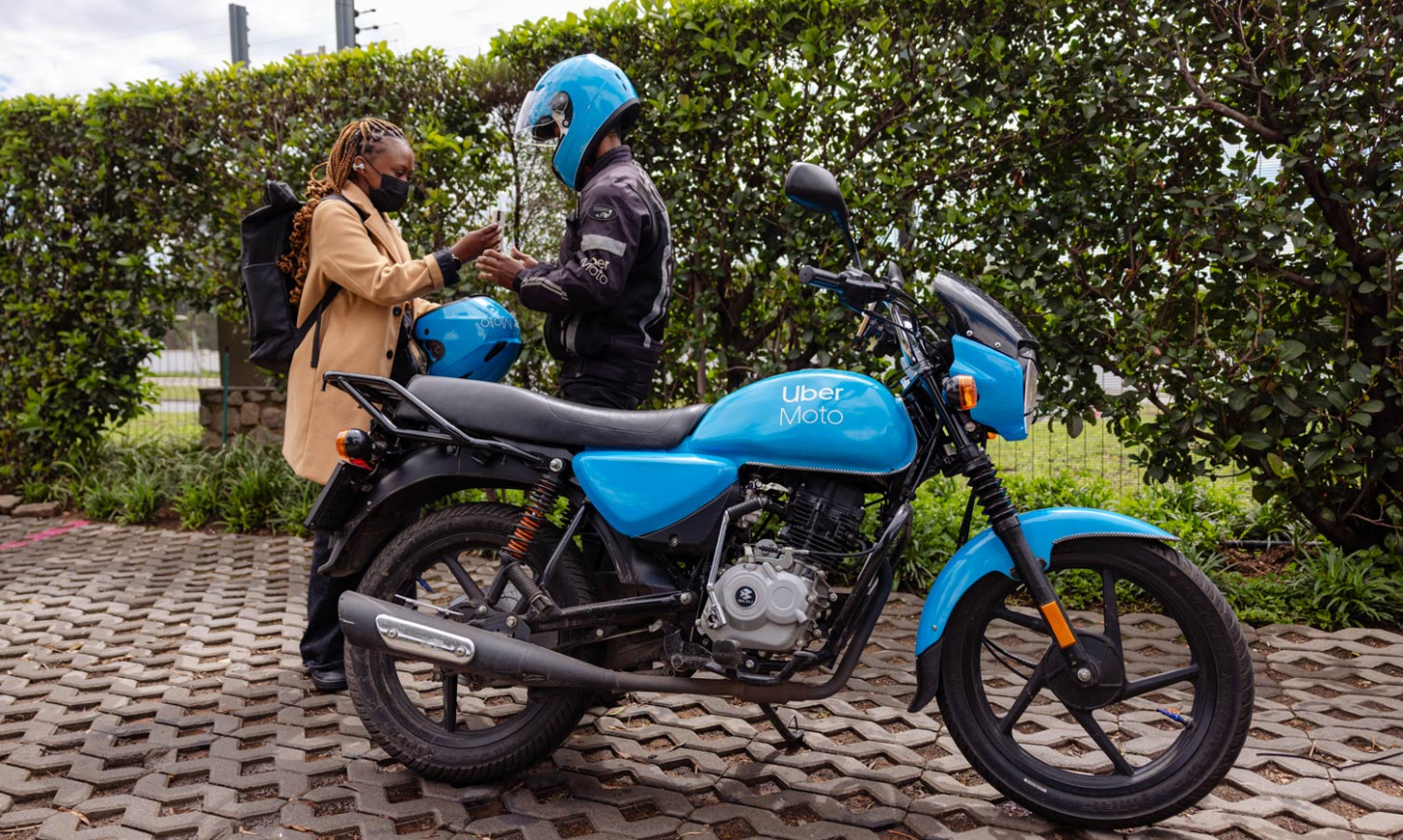
Uber Moto is expanding rapidly in South Africa, but safety concerns around training, helmets and regulation continue to dominate the debate. Picture Credit: TechCentral
By Aisha Zardad
South Africa — Uber is setting its sights on a major expansion of its motorcycle-based e-hailing service in South Africa, with plans to unlock as many as 300,000 new earning opportunities—despite mounting concerns over passenger safety.
The company recently committed R5 billion towards growing its mobility, delivery and digital footprint in the country, unveiling its ambitions at the South Africa Investment Conference. Central to that strategy is Uber Moto, a relatively new offering introduced in early 2026.
Initially rolled out in Johannesburg’s western suburbs, Uber Moto allows users to request a motorcycle ride and travel as a passenger on the back of the bike. Positioned as a fast and affordable solution for short urban trips, the service starts at just R18—making it one of the cheapest transport options currently available on the platform.
Uber believes the concept holds significant long-term potential in South Africa’s evolving transport landscape.
“We have seen a strong traction in new verticals over the past year,” said Uber General Manager for Sub-Saharan Africa, Deepesh Thomas.
“Moto, in particular, could become a core engine for transportation and e-hailing in South Africa over the next decade.”
Motorcycle ride-hailing is already widely used across parts of Africa, Asia and South America, particularly in densely populated cities where congestion limits traditional vehicle movement. Uber is betting that similar conditions in South Africa’s urban centres could drive adoption.
However, the rollout has triggered sharp criticism from local safety experts, who warn that the country’s road conditions, regulatory gaps and rider preparedness may not support such a service.
Hein Jonker, founder of the Motorcycle Safety Institute of South Africa, labelled Uber Moto a “foolish” service and that people with common sense should give it a “hard pass.”
“There are just too many variables to address and too few laws or regulations to effectively manage such a programme. I can say with confidence it will fail,” Jonker said.
“It’s about making money; it is not about the life carried by an incompetent and underqualified rider in an unsafe environment on a most likely incapable motorcycle.”
Rob Handfield-Jones, managing director of Driving.co.za, echoed those concerns, describing the service as “absurd” given South Africa’s already high road fatality rates.
Regulatory questions also remain. Under the National Land Transport Amendment Act, gazetted in September 2025, all e-hailing drivers are required to hold a professional driving permit (PrDP). However, experts argue that this requirement does little to address the unique risks associated with motorcycles.
A PrDP does not assess or certify motorcycle-specific skills—raising concerns about whether riders are adequately prepared to transport passengers safely.
Jonker stressed that specialised training should be mandatory for Moto drivers.
“It takes a whole different mindset and skillset to safely carry another person on the back of a motorcycle,” he said.
“They should be coached to handle a variety of scenarios.”
These include critical manoeuvres such as braking, turning, emergency stops, obstacle avoidance, as well as safe mounting and dismounting procedures. He added that riders should also be trained to brief passengers properly and have basic first aid knowledge.
Helmet safety presents another significant challenge. South African law requires both riders and passengers to wear correctly fitting helmets—something critics say may be difficult to enforce in a shared, on-demand system.
Handfield-Jones pointed out that it is unrealistic to expect riders to carry multiple helmets to suit different head sizes.
“A considerable percentage of passengers would have no option but to wear an ill-fitting helmet in contravention of the law, and at considerable risk to their own safety,” he said.
He also raised concerns about helmet integrity, noting that passengers have no way of verifying whether a helmet has previously been dropped or damaged—potentially compromising its effectiveness in an accident.
“How many prospective paying motorcycle passengers are aware of this risk?” he asked.
“Any serious motorcyclist knows that if you drop your helmet, its life is over.”
Uber has maintained that safety remains a priority. The company previously stated that Uber Moto provides helmets to users, along with guidance on safe pillion riding, including how to mount, dismount and wear protective gear correctly.
However, it has not provided clarity on how it ensures that helmets are appropriately sized for each passenger.
As Uber pushes ahead with its ambitious expansion, the success of Moto in South Africa may ultimately hinge on whether safety concerns can be convincingly addressed—before affordability and convenience come at too high a cost.