
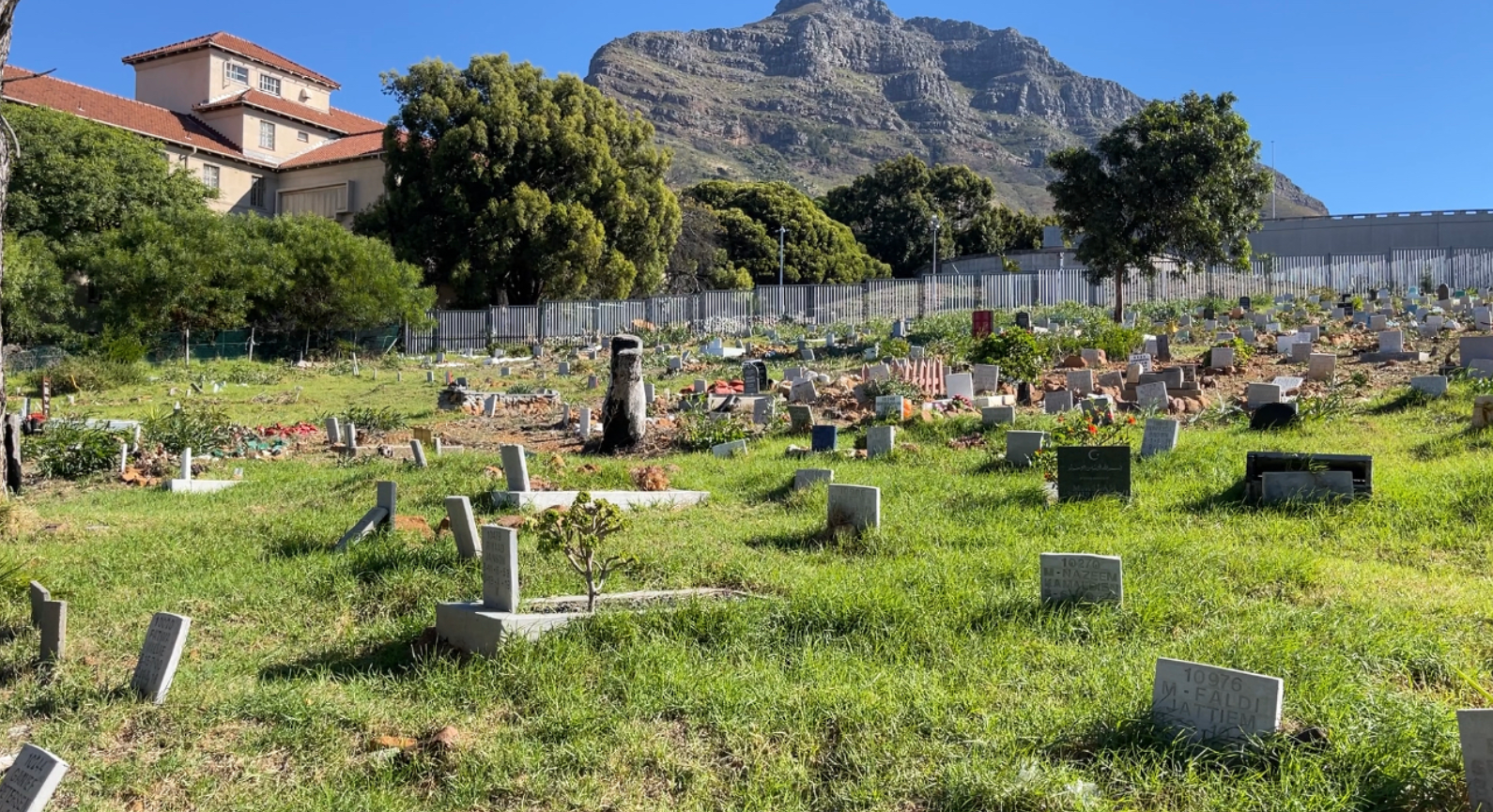
A court has ruled that the historic Mowbray Muslim Cemetery cannot be used for mortuary development, reinforcing its status as a protected burial site. Picture Credit: Mowbraycemetery
By Aisha Zardad
Western Cape — The Western Cape High Court has decisively blocked plans to build a mortuary at the historic Mowbray Muslim Cemetery, ruling that the land is strictly reserved for burial purposes and cannot be repurposed.
In a final interdict, Judge Gayaat Da Silva Salie barred the Muslim Cemetery Board from constructing, completing, operating, or maintaining any mortuary facility on the site, reinforcing the legal limits governing the use of the property.
The judgment stems from an application brought by Dr Tolgah Bassier, who challenged both the proposed development and the governance of the Board responsible for administering the cemetery.
Central to the case was whether a mortuary could be justified as part of the cemetery’s function. The court found that the answer lay in the property’s founding instruments, particularly the title deed, which explicitly states that the land “shall be used solely as a burial place for Muslims”.
The cemetery, acquired in 1886, has long served as a dedicated religious site where burials are conducted in accordance with Islamic rites, including ghusl and kafan. The court recognised the property as a waqf — a religious endowment — carrying strict obligations on how it is managed and used.
“The characterisation of the property as a waqf carries with it important legal consequences. Those who administer the cemetery do so not as owners, but as custodians or mutawallis (trustees), entrusted with preserving the property and ensuring that it is applied strictly in accordance with the purpose for which it was dedicated,” the judge noted.
Judge Da Silva Salie made it clear that any expansion beyond burial would breach that mandate, rejecting the Board’s argument that a mortuary would merely support burial processes.
“I find this contention problematic. Whilst certain preparatory acts may be closely connected to burial, the concept of what is ‘ancillary’ cannot be extended without limit.”
She warned that accepting such an interpretation would blur the boundaries of permitted use.
“On the Board’s approach, there would be little to prevent the inclusion of services such as pathology-related processes, hospital-linked functions, or the production and supply of burial-related materials, all on the basis that they are connected, in some attenuated way, to burial”.
The court further emphasised that the title deed reflects an intention for the cemetery to remain a quiet, dedicated space for burial.
“To accept the respondent’s construction would permit a gradual expansion of the defined purpose of the property under the guise of ancillary use”.
Beyond the mortuary dispute, the ruling also addressed governance concerns raised by Bassier, including claims that the Board had not held annual general meetings for around 15 years, effectively sidelining the broader Muslim community.
The court has now ordered the Board to reopen membership registration and convene a special general meeting within 60 days to elect a new governing body.
The newly elected body will decide the future of the existing structure, on condition that any use remains strictly in line with the cemetery’s purpose as a burial site.