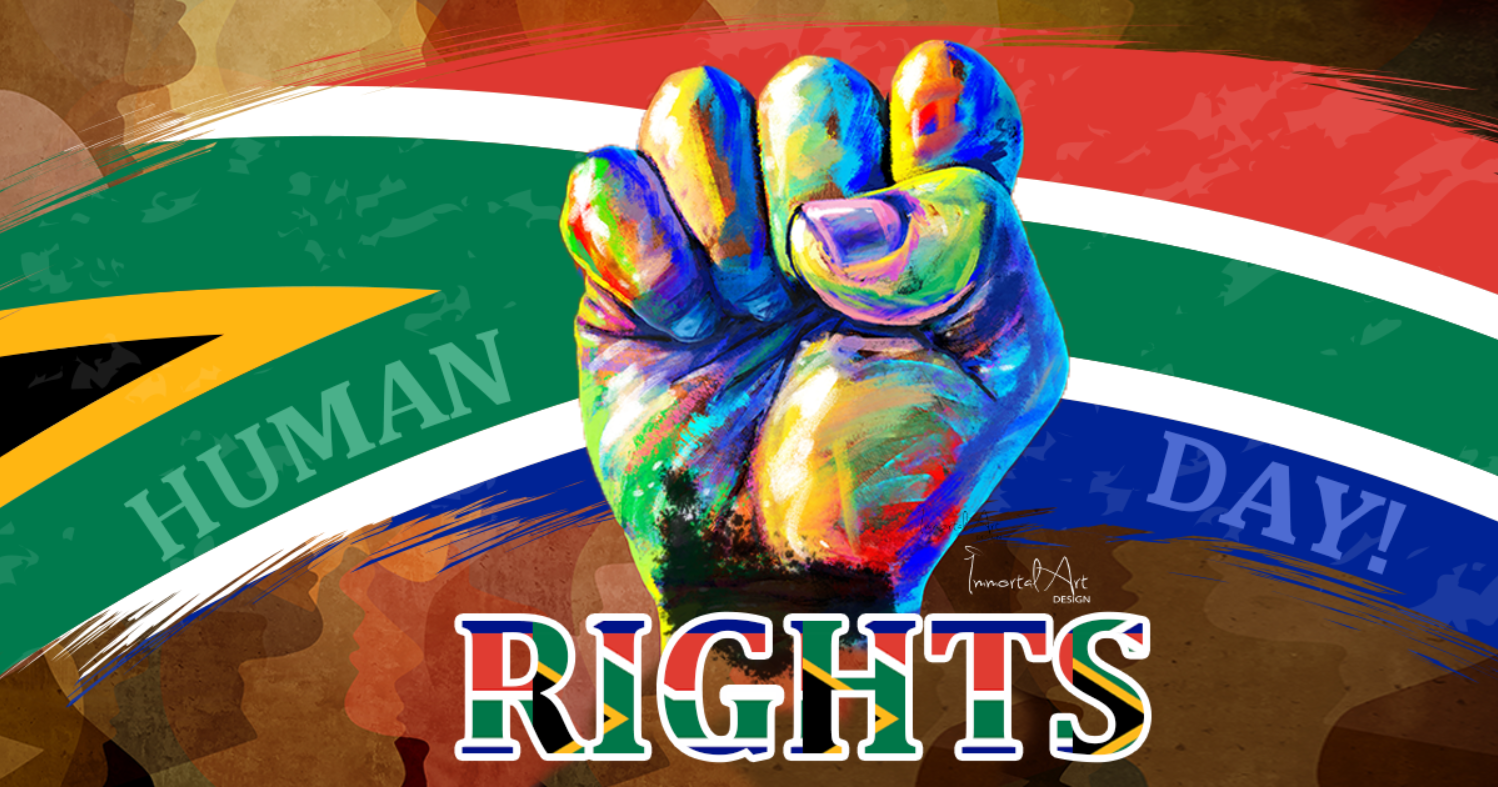
Human Rights Day reflects both the progress South Africa has made and the lived realities that still challenge the promise of dignity and equality for all. Picture Credit: Immoralart
By Aisha Zardad
South Africa — On paper, South Africa is one of the most progressive democracies in the world.
In reality, for millions, freedom still feels like something they are waiting to fully experience.
As the country marks Human Rights Day, the contrast between constitutional promise and lived reality becomes impossible to ignore. The rights to dignity, equality, education, and safety are clearly written into law — but for many South Africans, they remain distant, fragile, and, at times, out of reach.
For a generation born into democracy, the expectation was clear: a better life, shaped by opportunity and fairness. Instead, many young people are growing up in a system that struggles to carry that promise through. Unemployment remains one of the most defining challenges, not just as an economic issue, but as a barrier to dignity, independence, and hope.
But the struggle is not only about jobs.
It is felt in classrooms where resources are stretched thin, where potential is present but opportunity is uneven. It is felt in homes where putting food on the table is a daily calculation, not a guarantee. It is felt in communities where safety cannot be taken for granted, and where the simple act of moving freely comes with risk.
These are not abstract issues. They are lived experiences.
They are the reality of a student who studies on an empty stomach.
The reality of a graduate sending out application after application with no response.
The reality of a parent choosing between transport and food.
And in these moments, rights begin to feel less like protections — and more like promises still waiting to be fulfilled.
Human Rights Day is rooted in history, in the memory of those who stood against injustice and demanded a country built on equality and dignity. Their struggle was not theoretical. It was lived, fought, and paid for at great cost. And it is because of that sacrifice that South Africa has the foundation it does today.
But a foundation is not the same as a finished structure.
Decades later, the responsibility has shifted. The fight is no longer against a system of exclusion written into law, but against inequalities that persist in practice — shaped by poverty, systemic failure, and uneven access to opportunity.
This is where the weight of Human Rights Day truly lies.
It is not only about remembering the past, but about confronting the present. About asking difficult questions:
Why do so many still feel excluded from opportunity?
Why do basic rights remain inconsistent in their delivery?
Why does dignity still feel conditional for so many?
Because rights do not fail on paper — they fail in implementation.
Across South Africa, there are countless efforts to close this gap. Communities support one another where systems fall short. Civil society organisations push for accountability. Young people continue to strive, to study, to build, even when the odds are stacked against them.
There is resilience. There is effort. There is hope. But hope alone is not enough.
Human Rights Day calls for something more — accountability. From institutions, from leadership, and from society as a whole. It demands that rights move beyond policy and become lived, consistent realities for every citizen, regardless of where they live or what they have.
Because dignity should not depend on circumstance.
As the country reflects today, the message is both simple and urgent: progress has been made, but it has not been enough. The promise of South Africa’s democracy was never meant to be partial — it was meant to be shared fully, equally, and without exception.
Human Rights Day is not just a reminder of how far the country has come.
It is a reminder of how far it still has to go.