
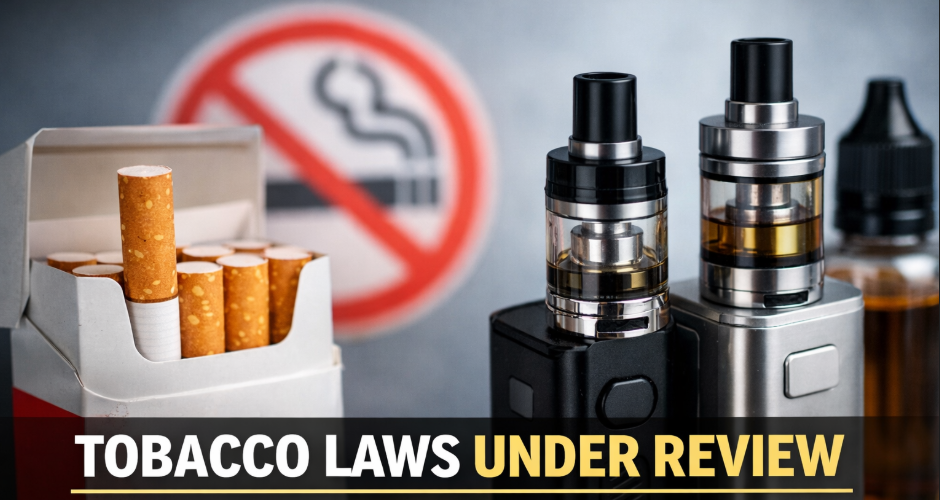
Electronic vaping devices and traditional cigarettes are displayed as South Africa reviews proposed tobacco control regulations that could tighten rules on smoking and vaping products. Picture Credit: Timeless News
By Aisha Zardad
South Africa – The Department of Health has proposed adjustments to aspects of the Tobacco Products and Electronic Delivery Systems Control Bill following public submissions, including changes to how certain tobacco and nicotine products are defined.
Among the key proposals is a clearer distinction between combustible products, such as traditional cigarettes, and non-combustible alternatives. The department indicated that some non-combustible products could potentially be exempt from specific restrictions contained in the Bill.
The legislation, which has been under discussion for several years, completed its most recent round of public consultations at the end of 2025. During the consultation process, stakeholders raised concerns about a range of issues, including the introduction of plain packaging, the growing illicit tobacco market, and the limited capacity to enforce new regulations.
The Bill broadly aims to tighten controls on tobacco use while addressing regulatory gaps surrounding nicotine-delivery systems such as vaping devices.
Some proposals in the legislation have received support from stakeholders. Restrictions on smoking in indoor public spaces, certain outdoor areas, and stronger measures preventing the sale of tobacco products to minors have generally been viewed more favourably.
However, other measures have faced strong opposition. In particular, proposals to prohibit tobacco advertising and promotion, along with requirements for plain packaging, have drawn criticism from parts of the industry.
Addressing the Portfolio Committee on Health, Health Minister Aaron Motsoaledi said many of the objections raised during consultations had not persuaded the department to reconsider the overall goals of the legislation.
He emphasised that the Bill is not intended to outlaw tobacco or nicotine products but to regulate their marketing and availability in order to protect public health.
“The Bill’s objective is therefore to decrease easy access, initiation, and illnesses caused by tobacco and nicotine use, to keep South Africans healthy and to reduce the strain on the health system,” he said.
The department also rejected arguments from parts of the tobacco and vaping industry that newer nicotine products, including vaping devices, represent a safer harm-reduction alternative.
Officials argued that this position is based on incorrect assumptions that smokers are unwilling or unable to quit nicotine.
“In reality, the majority of smokers dislike being nicotine dependent and want to quit,” the department said.
“Evidence-based tobacco dependence treatments—not vapes—exist and are safe and cost-effective. The goal is cessation and relapse prevention to achieve long-term abstinence.”
Health officials further noted that many newer nicotine-delivery products, including heated tobacco devices and e-cigarettes, still involve inhaling nicotine and therefore do not align with the broader public health objective of reducing addiction.
Despite defending the core principles of the Bill, the department indicated it is open to refining certain provisions in response to concerns raised during consultations.
One proposed adjustment involves revising definitions in the legislation to better distinguish between combustible and non-combustible tobacco products. This, the department said, would allow for more targeted regulation.
Authorities are also considering exemptions for certain non-combustible products—such as snuff, nicotine patches and e-cigarettes—from some packaging and labelling rules, provided these products do not make misleading claims about their health effects.
The department clarified that it does not intend to ban the use of snuff, noting its role in traditional cultural practices.
To improve enforcement, officials also proposed widening the pool of officers responsible for implementing the new laws. In addition to health inspectors, enforcement powers could be extended to metro police, provincial and national police services, traffic officers, port health officials, immigration officers and members of the Border Management Authority.
The move is intended to strengthen the government’s ability to combat illicit tobacco trade.
Industry groups had argued that plain packaging could worsen counterfeiting and illegal trade. However, the department rejected this claim, saying the measure would not interfere with existing anti-counterfeit protections.
“Plain packaging does not eliminate anti-counterfeit safeguards such as tax stamps, unique identifiers, track and tracing markings, security inks, covert markings and digital authentication codes,” the department said.
“Plain packaging standardises brand presentation to reduce product appeal and marketing power. It also enables the application of graphic and text health warnings.”
Concerns were also raised about the severity of penalties included in the Bill, which allow for fines or prison sentences of up to ten years for certain violations.
The department clarified that these represent maximum penalties rather than mandatory minimum sentences.
“Presiding officers have the discretion to sentence the offenders to lesser sentences due to mitigating circumstances. This provides protection to offenders,” it said.
Officials added that stronger enforcement measures combined with tougher penalties could help improve compliance with the law.