
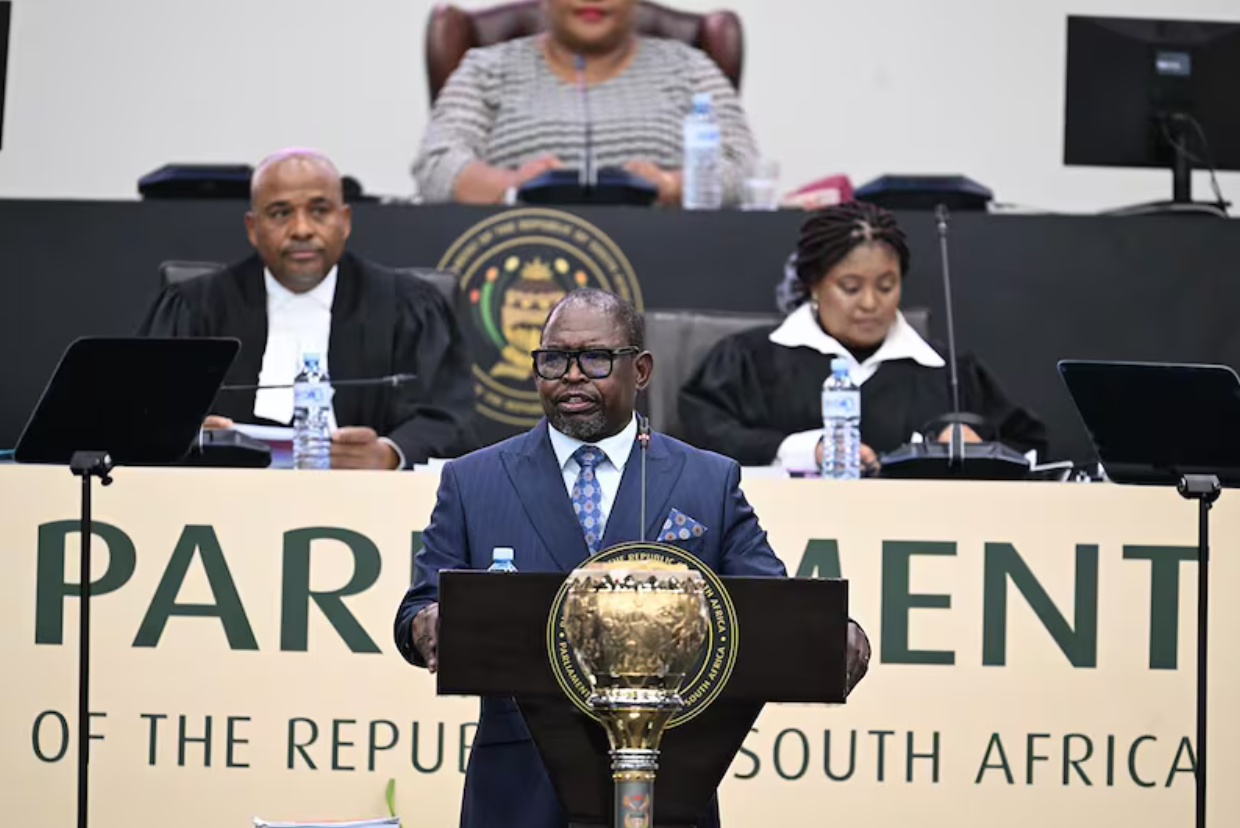
Finance Minister Enoch Godongwana delivers the 2026 National Budget Speech at the Parliament Dome in Cape Town, outlining fiscal stability, social spending, and key reforms for South Africa’s future. Picture Credit: Business Day
By Aisha Zardad
Cape Town – The 2026 South African National Budget Speech was delivered by Finance Minister Enoch Godongwana on Wednesday, 25 February 2026, at the Parliament Dome in Cape Town. After years of economic strain, including the fallout from the Covid-19 pandemic, state capture, and global shocks, the nation is finally seeing signs of fiscal stability.
“Five years ago, the outlook was stark,” Godongwana said. “State Capture had hollowed out critical institutions… the warning lights were flashing. Public finances were under severe strain and growth had stalled. Faced with this crisis, we chose not to be defined by it. We turned it into a catalyst for change.”
He emphasised that a disciplined fiscal strategy based on three principles — stabilising debt, investing in infrastructure, and spending better — had delivered tangible results. “Today, that commitment has delivered tangible results,” Godongwana said, noting a narrowing budget deficit, falling debt-service costs, removal from the FATF grey list, and South Africa’s first credit rating upgrade in 16 years.
Godongwana acknowledged the challenges ahead: weak infrastructure, logistics bottlenecks, and outbreaks of foot-and-mouth disease are still slowing growth. But there is cautious optimism. Real economic growth is projected at 1.6% in 2026, improving to 2% by 2028.
“Our growth strategy rests on four pillars: maintain macroeconomic stability, implement structural reforms, invest in growth-enhancing infrastructure, and build state capacity,” he said.
This is not just numbers on a page: it means small businesses may have more access to markets, farmers could benefit from better logistics, and households could experience more reliable public services if the reforms take root.
The minister laid out a fiscal path designed to balance responsibility with social need:
- Consolidated budget deficit narrows to 4.5% of GDP in 2025/26, improving to 3.1% by 2028/29.
- Gross debt stabilises at 78.9% of GDP and falls to 76.5% by 2028/29.
- The main budget primary surplus rises from 0.9% to 2.3% of GDP.
“Government will continue engagements on a principle-based fiscal anchor to entrench fiscal credibility,” Godongwana said, highlighting that fiscal discipline is the foundation for inclusive growth.
Key reforms are under way to unlock growth and improve service delivery:
- Energy: stabilizing electricity supply to attract private investment.
- Logistics: removing rail and port bottlenecks to lower costs.
- Local government: introducing performance-linked utility models.
- Housing and spatial planning: bringing communities closer to economic opportunities.
“These reforms are about more than numbers—they affect the daily lives of South Africans, from reliable electricity to faster transport for businesses and workers,” Godongwana said.
Godongwana announced the withdrawal of R20 billion in proposed tax increases, thanks to a positive revision of tax revenue by R21.3 billion. Personal income tax brackets and rebates have been fully adjusted for inflation, while retirement fund deduction limits and tax-free investment allowances have been increased.
“Improving fiscal position allows us enough room to withdraw the proposed tax increases, without putting fiscal sustainability or economic activity at risk,” he said.
Targeted savings of R12 billion over the medium term include enhanced social grant verification, which has already terminated nearly 35,000 fraudulent grants.
Finance Minister Godongwana outlined adjustments that directly affect households:
- Social grants: Old-age and disability grants rise to R2,400; the war veterans grant to R2,420; child support grant to R580.
- Fuel levy and excise duties: Fuel levies will rise by 9 cents per litre for petrol (R3.96) and 8 cents for diesel (R3.82), alongside carbon and Road Accident Fund (RAF) levies. Excise duties on alcohol and tobacco also rise: 20-pack cigarettes to R23.58, 340ml beer by 8 cents, 750ml wine by 15 cents, and 750ml spirits by R3.20.
Experts warned the impact is cumulative:
“Fuel is not simply a transport cost for motorists. It underpins the entire retail value chain. From farm to distribution centre to store, every product carries embedded logistics costs. A levy increase, even a modest one, gradually filters through these systems. It does not create a sudden spike in prices. It creates incremental pressure,” said Spar.
“Fuel increases are financially regressive. They hit lower-income households hardest. This is where emergency funds and careful cash-flow planning become essential,” said Tando Ngibe, Senior Manager at Budget Insurance.
“Consumers should not view this Budget passively. While sin taxes have increased broadly in line with inflation and the fuel levy has risen, these adjustments will still have an impact on monthly household budgets. Now is the right time for individuals to…adjust for these incremental cost pressures,” added John Manyike, Head of Education at Old Mutual.
Government plans to spend R2.67 trillion in 2026/27, with social services accounting for over 60% of non-interest spending. Key allocations include:
- Social Grants & Livelihood Support: The Social Relief of Distress (SRD) grant will continue at R370 per month for 2026/27, with discussions underway for a new Livelihood Grant to replace it. Old age, disability, and care dependency grants rise to R2,400, child support to R580, war veterans grant to R2,420, and foster care grants increase in two phases.
- Health: R410 million has been allocated over the medium term to the South African Medical Research Council to sustain vital HIV/AIDS research initiatives, following US withdrawal of funding. Total health spending rises to R334.3 billion by 2028/29, with 44.4% allocated to primary healthcare. R24 million is also redirected to the Office of Health Standards Compliance to fill critical posts and improve inspections.
- Education: Funding for post-school education and training is R155.8 billion for 2026/27, with the NSFAF supporting 744,203 students with R54.3 billion. Basic education is allocated R358.6 billion, including R33.9 billion for the National School Nutrition Programme and an expansion of early childhood development services from R12.2 billion to R18 billion over the medium term.
- Peace and Security: Funding for policing, defence, and border management rises to R291.2 billion by 2028/29. Deployment of the SANDF to tackle gang violence and illegal mining will be supported under emergency funding provisions, though exact costs are yet to be determined.
- Infrastructure: More than R1 trillion for transport, water, and energy projects, alongside utility model reforms for local government.
A government-led audit identified 4,323 “ghost workers”in the public sector. Salaries for unverifiable employees will be withheld, and verification includes facial matching against the National Population Register and physical inspections. The next phase integrates improvements to payroll systems for better oversight and expenditure management.
As the government balances fiscal pressures, some state services, like the South African Post Office, remain unfunded directly. However, revenue and expenditure reforms signal cautious optimism for growth, with R2 trillion projected in tax revenue, and measures such as VAT registration threshold increases aimed at supporting small and medium enterprises.
While SARS Commissioner Edward Kieswetter received a standing ovation during the Budget Speech, Godongwana gave a detailed tribute during a press briefing. Kieswetter transformed SARS from a state capture-affected institution into one the President could be proud of.
“You’ll recall that SARS was actually hollowed out at the time through the State Capture processes… It is through the commissioner that we’ve been able to transform that institution into what it is today. And we thank the commissioner for that,” Godongwana said.
The process for filling the new commissioner post is underway, with a likely appointment by 1 April 2026.
DA finance shadow minister Mark Burke welcomed the absence of tax increases and bracket creep.
“This budget displays a wholesale rethinking of tax policy by National Treasury under a coalition government,” he said.
But he warned that unemployment remains high and GDP growth of 1.6% is “unacceptably low.”
MK Party acting parliamentary leader Des van Rooyen criticised the modest growth projections.
“They always get these projections wrong. This is more of an exercise of balancing the books rather than addressing the plight of our people,” he said.
EFF leader Julius Malema argued that without real economic growth, infrastructure and job creation remain out of reach.
“The reality is that the economy is not growing… even if SARS collects more revenue, it does not mean economic growth,” he said.
GOOD Party secretary-general Brett Heron noted the absence of a meaningful Basic Income Grant.
“At R370 per month, the SRD does not lift a single recipient above the food poverty line. A meaningful Basic Income Grant is not charity; it is economic justice,” he said.
While the 2026 Budget signals cautious optimism, fiscal stability alone is not enough. Growth, job creation, and poverty reduction remain pressing challenges. Households, small businesses, and government institutions will watch closely to see if these reforms and investments translate into tangible improvements in daily life.