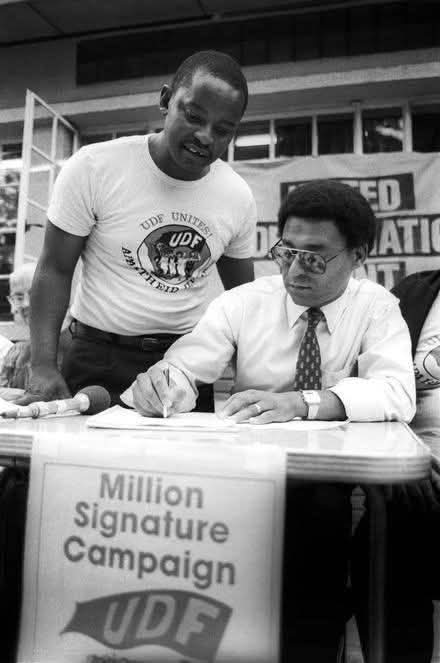
Mosiuoa Patrick Gerald Lekota and anti-apartheid clergy Dr Allen Boesak during their days with the United Democratic Front (UDF), actively engaging in the Million Signature Campaign. Picture Credit: Facebook
By Thulane Madalane
Kroonstad – South Africa is in mourning following the passing of Mosiuoa Gerard Patrick “Terror” Lekota, a towering figure whose life was inextricably linked to the nation’s struggle for freedom and its democratic evolution. Lekota, who has died at the age of 76, was a Robben Island prisoner, a key architect of the United Democratic Front, a minister in Nelson Mandela’s government, and later the founder of the opposition party COPE after a dramatic split from the African National Congress.
Born in Kroonstad, Free State, Lekota’s path of resistance began at the University of the North, from which he was expelled in 1972 for his activism with the South African Students’ Organisation (SASO), part of the Black Consciousness Movement. By 1974, as SASO’s Permanent Organiser, he was imprisoned on Robben Island for conspiring against the apartheid state, remaining there until 1982. Upon release, he helped found the United Democratic Front (UDF), the internal engine of mass resistance in the 1980s. This led to his arrest and conviction in the historic Delmas Treason Trial, with his sentence only overturned on appeal in 1989.
With democracy dawning, Lekota became a central figure in building the new South Africa. He served as the first Premier of the Free State, Chairperson of the National Council of Provinces, and as Minister of Defence from 1999 to 2008 under Presidents Mandela and Mbeki. His political journey took a decisive turn in 2008 when, as ANC National Chairperson, he broke away to form the Congress of the People (COPE), citing a departure from the party’s constitutional principles under the leadership of Jacob Zuma.
President Cyril Ramaphosa added his voice to the national condolences, paying tribute to Lekota’s foundational role in shaping democratic institutions. “He was instrumental in the establishment of the National Council of Provinces which added a new dimension of democratic inclusion to our parliamentary system and ensured communities all over our country could be heard and represented in our national legislature,” Ramaphosa said. Reflecting on Lekota’s later political path, the President noted, “His establishment of the Congress of the People reflected his commitment to the values and principles by which he had lived, and it added to the diversity of choices presented to the electorate as our democracy matured.” Ramaphosa concluded, “We will remember Mosiuoa for his patriotism, his intellect, and his personable nature, and we will continue to work for the inclusive, non-racial South Africa for which he sacrificed so much and worked so passionately.”
Tributes from across the political spectrum have highlighted his lifelong dedication and complex legacy. ANC Secretary General Fikile Mbalula stated, “We woke up this morning to the tragic news of the passing of our dear brother and someone we referred to as ‘Terror’. Because he struck terror at the heart of the apartheid regime… Mosiuoa Lekota will be remembered as being at the forefront of fighting for a free and democratic South Africa. As the ANC we remember our former national chairperson and extend our condolences and gratitude to his family and comrades.”
SAFTU General Secretary Zwelinzima Vavi offered condolences, saying, “SAFTU mourns the passing of Mosiuoa ‘Terror’ Lekota, a veteran liberation struggle stalwart and former political prisoner… His lifelong commitment to democracy, constitutional governance, and open political debate remains his enduring mark.” The Economic Freedom Fighters also acknowledged his passing, stating, “The EFF acknowledges Mosiuoa Lekota’s years as a liberation activist, political prisoner, and public servant. His political life reflected both the unity forged during the struggle against apartheid and the democratic era’s challenges.”
Lekota’s life embodies the sacrifices, triumphs, and difficult choices that have shaped modern South Africa. From the isolation of a prison cell to the halls of ministerial power, and finally to the arena of opposition politics, he remained a committed, if sometimes controversial, democrat. He is survived by his family, his comrades, and a nation reflecting on the passing of a generation that bore the full weight of history.