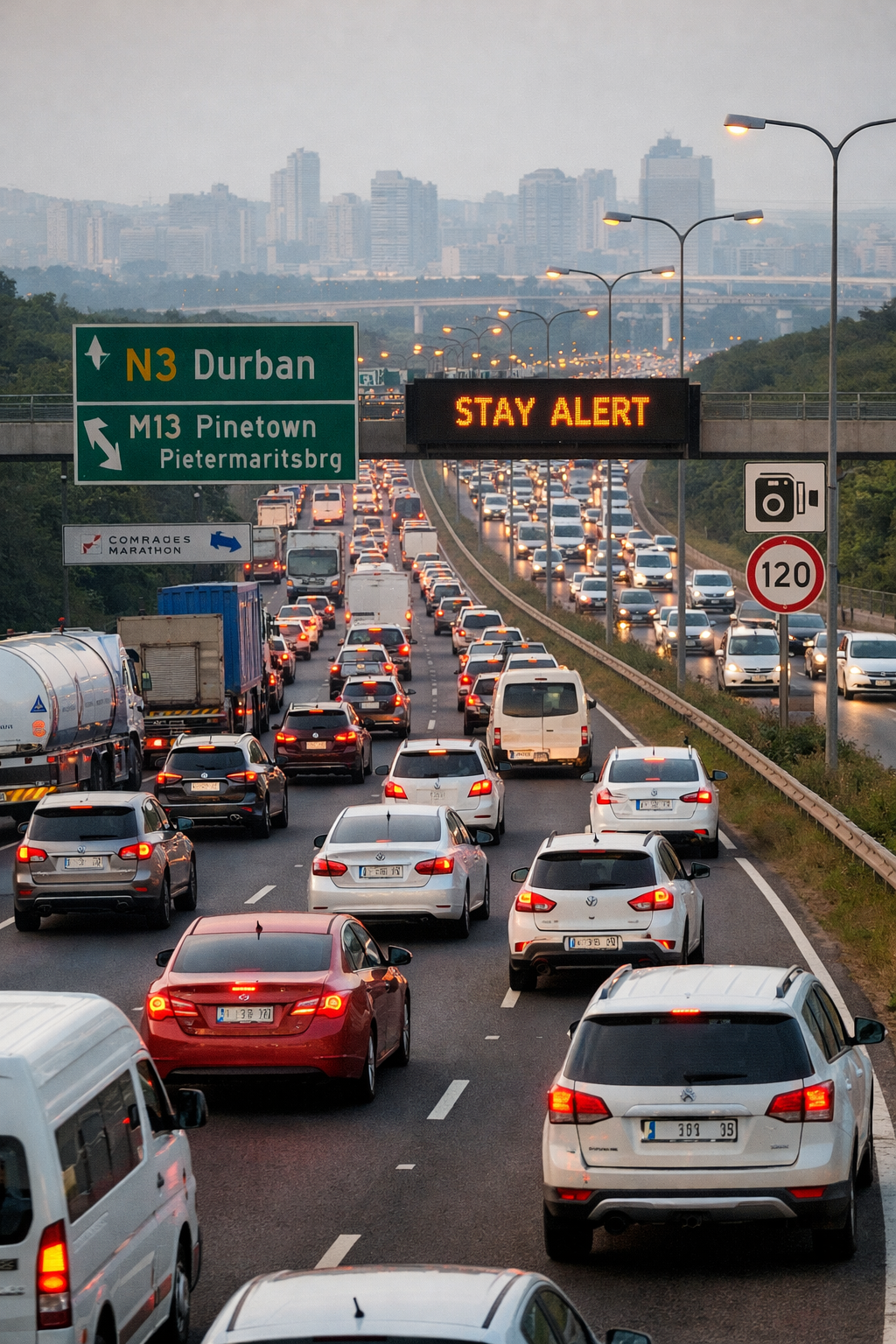
Traffic volumes surge along the N3 as Easter travellers hit the road, with authorities warning that peak days and unsafe driving behaviour could increase the risk of crashes. Picture Credit: TimelessNews
By Aisha Zardad
South Africa — Traffic along the N3 is already building as the Easter travel period gains momentum, with authorities warning that a mix of heavy volumes and risky driver behaviour could turn the holiday rush into a danger zone.
Early movement has set the tone for what is expected to be a sustained influx of vehicles throughout the week, before conditions intensify closer to the long weekend. Officials say the southbound route will carry the heaviest load as travellers make their way toward coastal destinations.
“Current traffic forecasts suggest that traffic volumes are likely to remain steady throughout the week, with busy traffic conditions expected in a southbound direction on Thursday, 2 April, and Friday, 3 April 2026,” the N3 Toll Concession said.
The return leg is expected to be even more demanding. As the long weekend wraps up and schools reopen, a sharp spike in traffic is anticipated, prompting authorities to halt roadworks along the route to ease pressure. Construction will be suspended from 2 April to 7 April, with only urgent repairs allowed.
Beyond congestion, safety concerns are taking centre stage — particularly when it comes to children travelling during the holidays. Road safety organisations say increased travel places young passengers at greater risk, urging families to treat safety as a non-negotiable.
“As our schools close and families begin their journeys, we must remember that road safety is a shared responsibility. We are calling on every parent and caregiver to be the primary protectors of our children,” said ChildSafe South Africa executive director Zaitoon Rabaney.
She added that compliance alone is not enough, urging parents to adopt safety as “a non-negotiable behaviour,” particularly through the correct use of child restraints.
Authorities stressed that children under three must be secured in proper car seats, while older children must wear seatbelts correctly. Overloading remains a major concern, with officials reinforcing a strict “one child, one seat” approach.
RTMC spokesperson Simon Zwane highlighted the urgency, noting that children aged between five and 19 made up 7.2% of road fatalities during the 2025 Easter period. He said this “makes it imperative for caregivers to take extra efforts to instil the culture of safe road usage among children to protect their lives and to reduce avoidable road injuries and fatalities.”
Driver behaviour remains a critical factor. Authorities warn that excessive speed, illegal overtaking and ignoring traffic signals continue to drive head-on collisions, while distractions such as mobile phone use further increase the risk.
A zero-tolerance stance on alcohol and drug use remains in place, with motorists urged to prioritise alertness and responsibility behind the wheel.
Passengers, too, are being called on to play their part. Travellers have been encouraged to refuse transport that is overloaded, unsafe or driven by someone who is fatigued or impaired — a principle described as exercising the “power of the fare.”
Data from Optix Africa paints an even clearer picture of the risks. Good Friday consistently emerges as the most dangerous day on the roads, with significantly higher incidents recorded compared to other travel days. Travellers are advised to either leave very early in the morning or delay their journeys to avoid peak pressure.
While the N3 remains a high-risk corridor, the N1 between Johannesburg and Cape Town has recorded even higher incident levels. Key hotspots include major urban interchanges, particularly along the Johannesburg–Pretoria route and sections approaching Durban.
Across all routes, the leading causes of crashes remain consistent — following too closely, delayed braking and drifting between lanes. With more than 47% of recorded incidents classified as near-collisions, authorities are urging drivers to maintain safe following distances and remain fully attentive at all times.