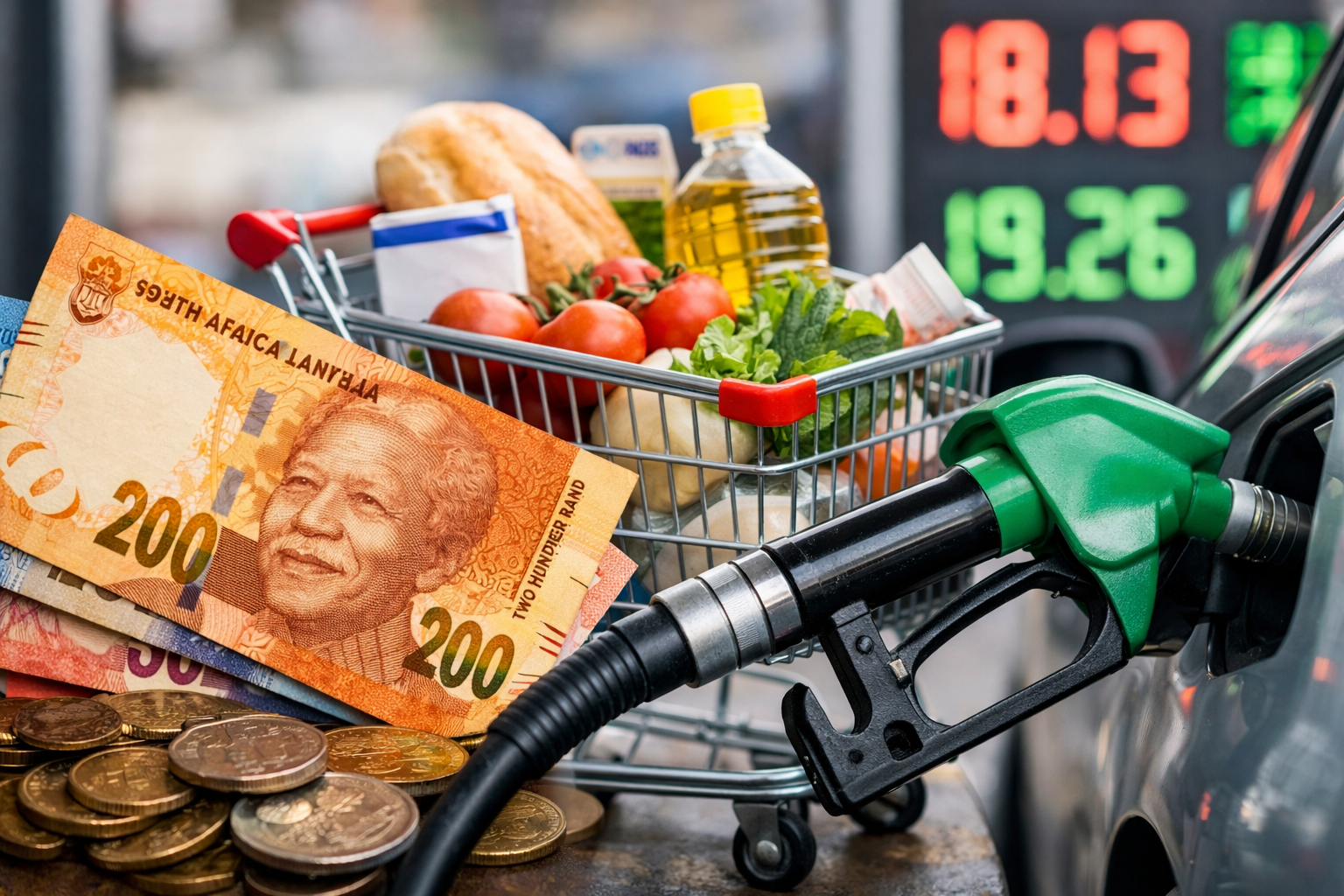
Rising fuel prices are pushing up the cost of food, transport and everyday living for South African households. Picture Credit: TimelessNews
By Aisha Zardad
South Africa — South African households are facing mounting financial pressure as sharp fuel price increases begin filtering through the economy, driving up the cost of transport, food and borrowing.
What began as a spike in global oil prices is now feeding directly into household expenses, with the impact cascading across the economy. Because fuel underpins transport, production and logistics, increases at the pump are quickly passed through to the cost of goods and services.
The South African Reserve Bank (SARB) has flagged growing inflation risks linked to the fuel shock.
“Given the oil price shock, we now project inflation to reach around 4% in the second quarter, with fuel inflation over 18%,” said SARB governor Lesetja Kganyago.
The central bank modelled two scenarios. In a shorter conflict scenario, inflation is expected to rise above 4%, requiring at least one interest rate hike before stabilising by 2027. In a more prolonged scenario, inflation could exceed 5%, with multiple rate increases needed before returning to target by 2028.
Economists are already revising forecasts upward. Nolan Wapenaar, head of fixed income and co-chief investment officer at Anchor Capital, said the SARB has lifted its 2026 inflation forecast to 3.7%, up from 3.3% earlier in the year.
Independent economist Elize Kruger warned: “The expected spike in fuel prices in early April will likely derail the moderate inflation outcome previously envisaged”.
Fuel price adjustments for April reflect one of the sharpest increases in recent years. Petrol has increased by R3.06 per litre, while diesel — widely used across the transport and agricultural sectors — has risen by between R7.37 and R7.51 per litre.
Although government introduced a temporary R3 levy reduction to soften the blow, fuel prices still reflect a monthly increase of roughly 15% for petrol and up to 40% for diesel.
The rand’s depreciation and global oil volatility have compounded the pressure, with oil prices recently hovering around $107 a barrel.
“Given the extent of these increases, the probability that these could trigger a widespread upward adjustment in prices across the economy is very high,” Kruger said.
For consumers, the impact is immediate. Based on average fuel usage, motorists could pay between R300 and R460 more per month.
Rising fuel costs are already feeding into food prices, starting at the production level. Higher diesel prices are increasing the cost of planting, irrigation, harvesting and transport, while fertiliser — a key input — remains expensive due to global supply constraints.
Transport costs account for up to 15% of the final price of food, sharply driving up retail prices. Estimates show food inflation could surge between 6% and 10%, adding R323 to R538 to monthly grocery bills.
“South Africa’s agricultural sector is uniquely exposed to global shocks,” said Sanele Nkosi, Head of Agriculture at BDO South Africa. “Farmers rely heavily on imported inputs such as fertilisers, fuel and machinery, while selling into globally priced markets.”
Nkosi noted that fertiliser can account for up to 50% of input costs in grain production, raising the risk of reduced planting or crop shifts if supply remains constrained.
The impact is also evident in travel costs, particularly airfares. Flight prices on some international routes have surged by as much as 170% in recent weeks, driven by higher jet fuel costs, rerouted flight paths and reduced capacity.
One traveller said flights from Cyprus to Cape Town, previously booked for R36,000, would now cost between R57,000 and R59,000 if rebooked.
“If we decided to buy new flights routed through Europe, it would have cost us between R57,000 and R59,000 per person… in 2022 we paid R12,000 for a return ticket,” the traveller said.
As inflation accelerates, pressure is also building on monetary policy. The SARB faces reduced room to cut interest rates, with the risk of further hikes increasing.
The central bank recently kept the repo rate unchanged but revised its inflation outlook, signalling concern over second-round effects from fuel-driven price increases.
PSG senior economist Johann Els said the risk outlook has shifted, with at least one 25 basis point interest rate hike now a strong possibility.
Higher borrowing costs would deepen the financial strain on households already grappling with rising living expenses, with the next interest rate decision due in May.